he/they
Hear me as Fig in Ghost Wax: Mazemouth!
Audiobook reel
Updated CHARACTER REEL coming soon!
In need of an awkward teen, determined hero, arrogant genius, or other voice?What about a writer with a keen eye for detail and a deep understanding of storytelling?For either, you're in the right place!No GenAI utilized in any aspect of work
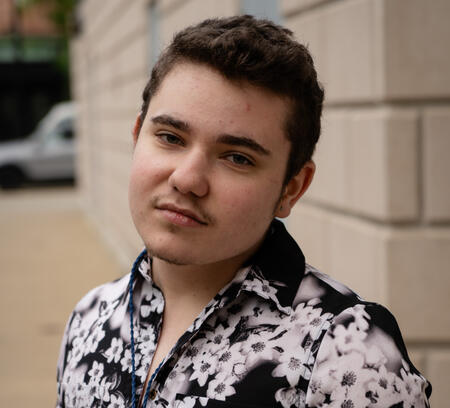
Adrian Northam is a transmasculine, non-binary voiceover artist based in Pennsylvania. He got his start in performing when he was small, in the form of singing lessons and concerts. He also started writing stories when he was only nine years old. He carried that creativity into his teenage years, where, pre-transition, he portrayed such people and characters as Anne Frank in The Diary of Anne Frank and multiple smaller roles in Annie. At age 16, he had the privilege of becoming a published writer (under his birth name at the time) as a short story of his appeared in a collection. Adrian recently performed in ensemble roles in Insert Coin, and has been engaging with the world of voiceover since January of 2025.Outside of acting, Adrian works in court transcription. They also enjoy playing TTRPGs and spoiling their cat alongside their husband.
More voiceover samples coming soon!
> Voiceover classes taken with Edge Studio, Sarah Nightingale, Marin Miller, Avi Roque, and other seasoned acting professionals> Able to breathe life and complexity into your characters — with emotions powerful or subtle, expert-level breath work, and a wide range of pitches> Specializing in young (children through 20's) masc or non-binary characters> Accents: general American; southern American> Trained singer
Home studio setup:
> Rode NT1 5th Gen Microphone
> Pop filter
> Scarlett Solo 3rd Gen Audio Interface
> Acoustic foam panels
> Small closet
> Writing on a near-daily basis since age nine
> Majored in English writing with a fiction focus in college
> Avid writer of scripts, articles, and prose
> Keen eye for grammar, and excellent sense of natural dialogue
The following is from a research project, intended as a mental health intervention for LGBTQ+ adolescents.What happened?
Rosa was a freshman in high school when her older sister caught her trying on girls’ clothes. Her sister made an Instagram post mocking her, and within just a few hours, word spread throughout their small town that Rosa was a transgender girl. Rosa had very few friends to begin with, and her popular sister’s mockery of her just made that worse.The biting comments, the glares at school and on the street, the slurs and fists hurled at her — they brought Rosa to tears. She shut herself in her room and sobbed, unable to face her family. The worst of it, though, was not all that harassment. The worst of it came from her longtime friend, Tristan.She and Tristan were always inseparable. They had talked before about LGBTQ+ issues, and Tristan implied he was supportive. Rosa held out hope that, even if her community’s hatred was hard to handle, her best friend would stay by her side.Tristan sent her a text a few hours after the Instagram post that outed her. Hey, I saw the post. Not sure what to make of it. What name do you wanna go by now?At first, Rosa got her hopes up: he wasn’t being hateful, not yet. She responded. I really like the name Rosa.Ok. This was all she got from him before, days later, when she was worn down by everything, he sent the message she couldn’t stop reading over and over. Look, I still don’t know what to make of all this. People have been asking me about you. They’re making fun of me. And I don’t think this is right for you. So I can’t talk to you anymore unless you stop this transgender stuff. Stop.What did she do?
In her despair, Rosa could not think of a single person in town who would listen to her crying. Of course, people like that did exist – some teachers and peers at school seemed supportive, in her experience – but, understandably, she did not trust them fully in that moment, since Tristan had broken her trust so thoroughly. She’d heard, though, of crisis hotlines for LGBTQ+ people, which would be supportive without a doubt. She searched up the phone number for one and, with trembling hands, placed a call.The man on the other end greeted her, introduced himself as Matthew, and asked her for her name (to which she hesitated a bit), her age, and where she lived. He had the lisp she had come to think of as stereotypically gay, yet he spoke clearly and proudly with it. “Thank you for calling, Rosa. That’s very brave of you. What’s going on today? What would you like to tell me about?”Once she told Matthew of her best friend’s hurtful words, he sighed. “That’s so awful, Rosa. So, so awful. I’m sorry. I know it’s hard, when a friend chooses to be so mean.”Again, tears welled in her eyes. “I feel like he’s right. I need to stop. I just… wish I’d never tried on those girl clothes. I wish I could stop thinking about being a girl. Everyone hates me now.”“I can tell you’re having a hard time, and I understand. That happens sometimes in small towns.” His tone became more firm, not to be harsh, but to be clear and confident. With the way he spoke, she almost started believing him. “But that’s not your fault, Rosa. The world is so hateful sometimes. All you want is to be yourself. There’s nothing wrong at all with wearing skirts or trying on makeup. Nothing wrong at all, I mean that.”“I feel like there is.” She sobbed quietly. “I don’t know. I don’t know what to do. I kind of just want to disappear.”“I understand. It sucks. This sucks. I wish this didn’t happen to you. I just want to validate that, that this sucks, a lot.” He paused, giving her time to cry a bit more before he continued. “But this won’t last forever, I promise you. Think about it: one day you’ll be able to move somewhere else, somewhere with lots of other trans people. You’ll be able to transition to your liking: wear the clothes you enjoy, go on hormones if that’s something you want, make friends who call you Rosa and she/her without a problem, and celebrate all those transition steps with you. They’ll squeeze your hand and squeal for you and take you out to some nice restaurant to cheer for you. Right now, the world feels like it’s crashing down. I get that. But the world is also very nice. There are parts of the world you can go to where you can — no, will — be happy. You will be happy, Rosa.”She could not think of a response. She just cried more, and Matthew talked her down. Once they were done, she thought again of Tristan’s text. She almost opened her messaging app to read it again, but she decided against it, and just laid on her bed, listening to her favorite songs, calming music from video games she’d played years ago, to calm down. She may still be stuck in this small town for now, and Tristan may have turned his back on her. She still had a few good cries left about it all. But Matthew was right. Things would get better, and that was worth sticking it out for.
Content warning: this piece discusses rape and sexual assault in some detail. Written in July 2024.After season 4, episode 6 of Amazon’s The Boys came out, its creator’s interview brought with it an onslaught of controversy. It’s no mystery why; 20 minutes of this episode, released on July 4, 2024, are dedicated to a graphic scene of sexual assault and torture.What I and many others find particularly unsettling is the difference between this and a separate instance of sexual assault — in the same show. Some viewers, as well as those involved in the making of the show, felt that The Boys’ first season handled the character Starlight, her rape, and her arc generally with the respect and complexity they deserve. Why was the showrunner, Eric Kripke, so cautious about portraying Starlight’s victimization correctly, while calling Hughie’s victimization “hilarious?”A contributing factor to this contrast is the genders involved. Season 1’s assault features a female victim, while season 4 features a male victim. There are other distinctions between the two scenes within the story, but the gender difference is of particular interest. The Boys unfortunately follows a broader pattern when it comes to sexual violence towards men in fiction.Fiction has historically handled sexual violence against any gender poorly. Thanks to #MeToo, among other social movements, this trend has shifted in recent years: survivors of sexual violence have been able to speak about personal experiences to a more receptive public. With increased awareness of sexual violence comes higher standards for its portrayal in fiction.The primary forces behind #MeToo and similar movements were women, understandably. Because of widespread misogyny and objectification, women were, and still are, in dire need of a space to discuss their experiences. But male victims often hesitate to join in when speaking about sexual violence. There are myriad reasons we opt not to discuss our experiences; many are similar to women’s reasons, while others are more gender-specific.Rather than serving as an escape, or a compassionate representation of sexual violence, fiction often ends up reinforcing these reasons. Many male victims are portrayed poorly in stories, their trauma mocked, their identity challenged. Numerous stories carelessly echo the responses men receive when we speak up, feeding into cultural norms that silence victims of any gender.“It’s okay because you wanted it”
Dan Simmons’ The Fall of Hyperion won several awards and nominations. Had an award existed for objectifying female characters, it could well have won that, too. Simmons not only reinforces the long-standing misogyny of the science fiction genre in this 1990 novel, but also downplays the trauma endured by a major male character in the process.In one particularly hard-to-read chapter, Colonel Fedmahn Kassad is raped by his love interest. This isn’t a stretch; the novel explicitly uses the word rape as he is described fighting back and saying, “No.” Eventually, he gives in and goes along with what she’s doing.A few chapters later, when the narration returns to Kassad’s perspective, any possible exploration of that traumatic experience is thrown out the window:“Kassad remembered the assault on him at the Tombs, knowing now that it was less a rape than a granting of his own wish, his own sub-vocalized desire to be lovers with this improbable woman once again” (184).Male victims of sexual violence, especially those whose perpetrators were female, are sometimes met with the refrain that men always want sex, and that therefore the rape of a man by a woman is impossible. This simultaneously downplays male victims’ experiences and reinforces the objectification of women. It’s as though women are incapable of doing harm, reduced only to their sexual desirability; meanwhile, men are thought incapable of being harmed. This notion shows up in cases of female pedophiles targeting boys, as well, to which many men say, “I wish that were me,” or similarly dismissive phrases.It goes without saying: men are human beings. We do not, in fact, always want sex. Further, even if the Colonel truly wished to have sex with his love interest in that moment, the fact that she pinned him down and initiated without so much as a word still makes this rape. Wanting does not equate to consent.“Being a victim makes you unmanly”
The Simpsons has never been afraid to dive head-first into sensitive subjects. After all, it came into existence as a popular and fierce display of counterculture. While it’s no surprise that the show has depicted sexual violence, the way it did so in this scene from the 2003 episode “The Strong Arms of the Ma” speaks to an alarming trend.Here, Marge takes on a traditionally masculine role, with her bulging muscles and domineering attitude, while Homer becomes traditionally feminine. Marge calls him the common sexually-charged phrase “hot stuff” before raping him. He is then shown having to prepare the kids’ lunches the next day, usually an act done by his wife. The subversion of gender roles is the joke here — it is supposedly absurd for a woman to force herself on a man, and for a man to be submissive and take care of kids. Since one happens right after the other, this scene also implies that being raped is what turned Homer into this feminine caretaker. Tying together feminine qualities and victimization adds yet another layer of misogyny to this already-messy scene.Masculinity is not diminished by being sexually assaulted. Nor, I should add, is masculinity a measure of worth to begin with. Still, surrounded by the world’s patriarchal ideals, many men feel as though their rape makes them lesser.“No one will take you seriously”
Released in 1997, Final Fantasy VII’s fame has lasted into the modern day, having sold 14.10 million copies worldwide and earned itself a remake. It may then be displeasing to learn that this old classic game depicts an implied rape of the male protagonist, Cloud. Some argue this scene is a joke related to Japanese bathing culture, which is something I cannot speak on, given my lack of connection to Japan. Even so, the protagonist’s clear discomfort at being naked with overly-affectionate, forceful strangers is enough to make the scene stick out. Not only is this scene played for laughs — lighthearted, goofy music plays throughout — but it also adds more than a bit of homophobia, with the perpetrators being scantily-dressed men.Many Final Fantasy players laugh at this scene and deny the uncomfortable nature of it, whether in forum posts or YouTube comments. In fact, scenes like this are commonly meant to be comedic. The implication is that it’s impossible for men to be legitimately sexually victimized, impossible for their trauma to legitimately weigh on them. Rather than representing and validating the struggles of male victims, people treat said struggles as nonexistent, with a lighthearted tone — or, in the case of The Boys, as “hilarious.”It may be strange that all three examples above are from prior to 2005. There are certainly modern examples of poorly-written male victims (aside from The Boys, of course). The main reason for these choices, though, is that the above are culturally significant. The direct prequel to The Fall of Hyperion sold more than 1 million copies; The Simpsons is a well-known phenomenon which received 33.6 million views on its most-viewed episode; and Final Fantasy VII made a lasting impact on the video game industry. Each is also from a different medium entirely, as this issue goes beyond just one type of story.Thankfully, Final Fantasy VII’s remake from 2020 removes the aforementioned implied-rape scene and changes the context surrounding it. Likewise, the recent outcry against Amazon’s The Boys paints an optimistic picture. Male victims are following the wave of #MeToo, being taken more seriously and critiquing fictional portrayals that disrespect them. Men like Terry Crews have spoken out, too, reminding other men that we are seen and valued, and that our experiences are real.Audience opinion has shifted in some ways when it comes to the sexual assault of fictional men. In spite of the progress made, though, men’s victimization is still very often played for laughs. The fact that Eric Kripke felt comfortable saying what he said demonstrates that we still have a long way to go.
Late spring, 2015, at 4pm. The halls of Greene Star High School, a long row of lockers and prom posters. Most students have left; a few stragglers have congregated around particular lockers to talk in groups. CHARITY, a freshman, is alone and putting their ice skating supplies into their locker. FABIÁN, also a freshman, hesitantly approaches CHARITY.FABIÁN: Hey, you’re Sydney’s kid, right?CHARITY bristles.CHARITY: Yeah. What, are you gonna make fun of her? Call her a slut?
FABIÁN: What? No. It’s just that my great aunt is her— your mom’s stepmother.
CHARITY: And?
FABIÁN: I just like to keep track of my family tree. What’s your name?
CHARITY: [Mumbling] Right, totally normal greeting for the new person, hi, nice meeting you too.
FABIÁN: Hm?
CHARITY: Charity. My name’s Charity.FABIÁN pulls his phone out of his pocket and starts typing.FABIÁN: I’m Fabián. So this makes you… second cousins with me. Or step-second cousins.
CHARITY: Weirdo.FABIÁN tucks his phone away.FABIÁN: Hey, it’s not often I get a new family member who isn’t a newborn.
CHARITY: Family member?
FABIÁN: Sorry, is that a bit much?
CHARITY: You think?
FABIÁN: A new friend, then.CHARITY crosses her arms and glares at him silently.FABIÁN: A new acquaintance? A fellow victim of family drama?
CHARITY: My mom is the only family I have. Back off.
FABIÁN: Ah, sorry. What do you say though? To being acquaintances?
CHARITY: [Scoff]
FABIÁN: [Sighing] Look, people don’t like your mom. Or you. You totally caught onto that.
CHARITY: Wow! Great job being my acquaintance so far.
FABIÁN: The thing is that people don’t like me, either. My family doesn’t. Most other townspeople don’t. I’d love to have an ally in this godforsaken town.
CHARITY: Christ, dude, you should’ve said that at the start. I’m so in.
FABIÁN: Really?CHARITY extends her hand, and FABIÁN shakes it.CHARITY: Partners in crime?
FABIÁN: Crime? I-I mean— yeah, sure!